Perry Stokes Airport (KTAD)
📑 Reports
Development Timeline
Click any project bar to view details
Airport Vision
Purpose
Further development of the historic Perry Stokes Airport will require a coordinated effort between business stakeholders and public entities. This proposal provides a 10 year development roadmap with key milestones that are needed to create new economic opportunities at and near the airport. The milestones in this report are a mix of private and public development efforts.
Vision
Our vision for Perry Stokes airport is to create opportunity. By reducing the infrastructure, business incentive, and aviation service barriers to growth, we believe development will occur. The milestones established in this report are intended to encourage general, commercial, and military aviation utilization that will benefit our community and fund continued airport growth.
- A full service FBO capable of meeting all aircraft support demands, including overnight hangaring capability
- Runway access and safety improvements
- Dedicated helipads and hot refuel points to deconflict rotary and fixed wing traffic
- Up to 12 privately owned 60x60' (or similar sized) hangars
- Support to an industrial park focused on advanced manufacturing businesses
By 2035, conditions are set to pursue more advanced aviation opportunities, such as a flight for life base, boutique passenger air service, or vocational flight and maintenance training.
Current Limitations to Growth
The last two years have shown significant growth across General, Business, and Military Aviation segments. However, further growth is limited by a number of infrastructure and service factors:
- Apron and Traffic Pattern Capacity: Due to a high volume of helicopters using the airport, parking is limited and the traffic pattern is often busy.
- Overnight Hangar Capacity: No overnight hangar capacity results in reduced overall utilization of the airport by business aviation customers. Aircraft that do visit the airport are less likely to stay overnight due to severe weather risks.
- Runway Access: No parallel taxiway and no provision for aircraft to turn around on Runway 03 makes access to the runway challenging and potentially hazardous when the airport is busy.
Immediate Airport Infrastructure Needs:
Immediate Airport Facility Needs:
Immediate FBO Service Expansion Needs:
Is Commercial Passenger Service Possible at KTAD?
Commercial Air Service at Perry Stokes Airport is a long term vision requiring 10-15 years of sustained investment and demonstrated growth. This section establishes the realistic framework for achieving scheduled passenger service while setting appropriate expectations.
Similar Communities Have Achieved This
- San Luis Valley Regional Airport (Alamosa): With a service area population only modestly larger than Las Animas County, Alamosa enplanes over 12,000 passengers annually through Essential Air Service Subsidy.
- Taos Regional Airport: Perhaps the most relevant model, Taos enplanes over 6,800 passengers per year through scheduled public charter routes to Austin and Denver—achieved without EAS designation or the federally rigorous Part 139 Airport certification.
Two Paths to Commercial Service
| Essential Air Service | Scheduled Public Charter | |
|---|---|---|
| Federal Subsidy | Yes - DOT subsidizes operations | No - market-driven |
| Airport Certification | FAA Part 139 required | Part 139 not required |
| Federal Oversight | Extensive - inspections, ARFF, staffing | Standard GA requirements |
| Passenger Cost | Lower (subsidized fares) | Higher (unsubsidized) |
| Trinidad Viability | Possible but highly unlikely | Primary pathway |
Infrastructure Prerequisites
Commercial service cannot be solicited until critical CIP projects are complete:
- 2028-2033: Runway 03 Turn Around ("teacup"): Runway 03 cannot support larger passenger aircraft without a spot to turn around and back taxi.
- 2035: Runway Extension to at least 7,500': This project is an extremely large project but is a pre-requisite to allow takeoff and landing for larger aircraft carrying many passengers.
- 2035: Appropriate Passenger Facilities: When passenger service is scheduled, Pinnacle Jet Centers will vacate the historical airport terminal which will require further modifications to render it effective for passenger operations. The airport will require parking facilities to meet the increased parking demand.
- 2035-2037: Partial Parallel Taxiway: Larger charter carriers may be willing to use a teacup as an interim solution, but a full length parallel taxiway will be a necessary long term runway access solution.
Community Conditions Necessary for Commercial Air Service
Infrastructure alone does not justify commercial air service. Scheduled public charter flights operate without federal subsidy, meaning fares will be higher than subsidized routes. Service viability depends on local area travel demand.
Pinnacle Jet Centers' role: Our mission is to promote development of Perry Stokes Airport for the benefit of aviators and the local community. We will continue laying the groundwork for commercial air service from the facility and operations side—pursuing passenger terminal upgrades, generating increased business aviation activity, pursuing hangars, and expanding services. This work proceeds regardless of whether commercial service is ultimately pursued, as it supports the airport's broader growth.
The community's role: Only community stakeholders and elected officials can determine whether funding costly infrastructure upgrades in pursuit of commercial passenger service is in the community's best interest. This decision requires a deliberate assessment of whether Trinidad and Las Animas County have reached the economic conditions necessary to sustain air service. We recommend that Las Animas County, the City of Trinidad, Trinidad State College, and the Emergent Campus collectively develop a set of community readiness conditions that indicate that the local area is ready to support commercial air service.
Potential readiness indicators might include:
- Advanced manufacturing presence: An operational industrial park with one or more advanced manufacturing employers generating regular business travel demand.
- Technical industry growth: Establishment of homegrown or relocated technical companies providing higher-wage employment and attracting out-of-region visitors.
- Piñon Canyon workforce expansion: Increased civilian and contractor employment at the Piñon Canyon Maneuver Site, generating consistent government-related travel.
- Population growth: Population growth in Trinidad and Las Animas County may point to growing economic vitality.
- Tourism infrastructure expansion: Development of major attractions such as expanded ski operations at Cuchara, destination lodging such as Cougar Canyon, or outdoor recreation facilities drawing visitors from beyond driving distance.
- Healthcare or educational anchors: Expansion of Trinidad State College programs or Mt. San Rafael Hospital services that draw students, patients, or professionals from a wider region.
- Corporate or institutional investment: Relocation or expansion of businesses with headquarters or operations elsewhere, creating regular executive and employee travel needs.
Airport Operations Data
Civilian Jet & Helicopter Operations: A Growth Story
Civilian jet and helicopter operations have grown dramatically—from just 80 operations in all of 2024 to 289 in 2025, a 261% increase. Through September, 2026 has already recorded 412 operations, surpassing all of 2025. With the airport rental car fleet and hangar share program now in place, we expect this trajectory to continue.
2024 Civilian Jets & Helos
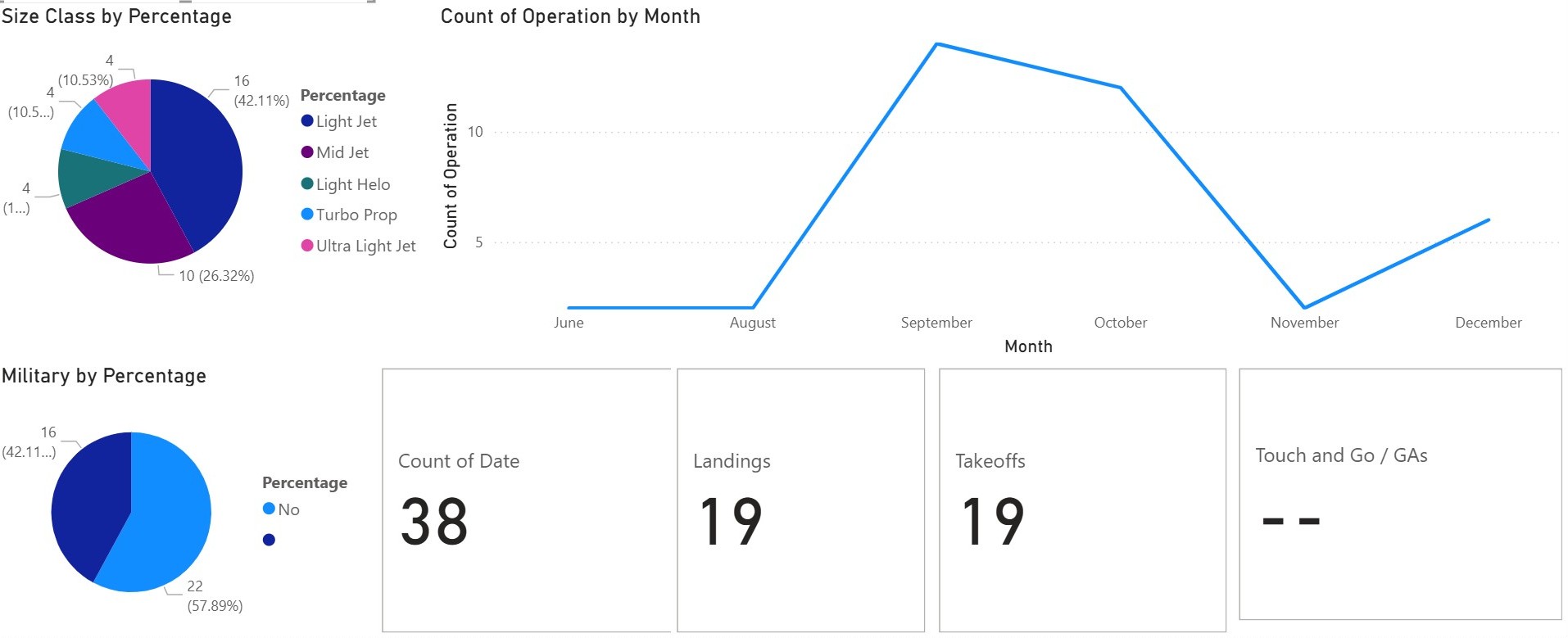
80 total operations (40 takeoffs, 40 landings)
Click to enlarge
2025 Civilian Jets & Helos
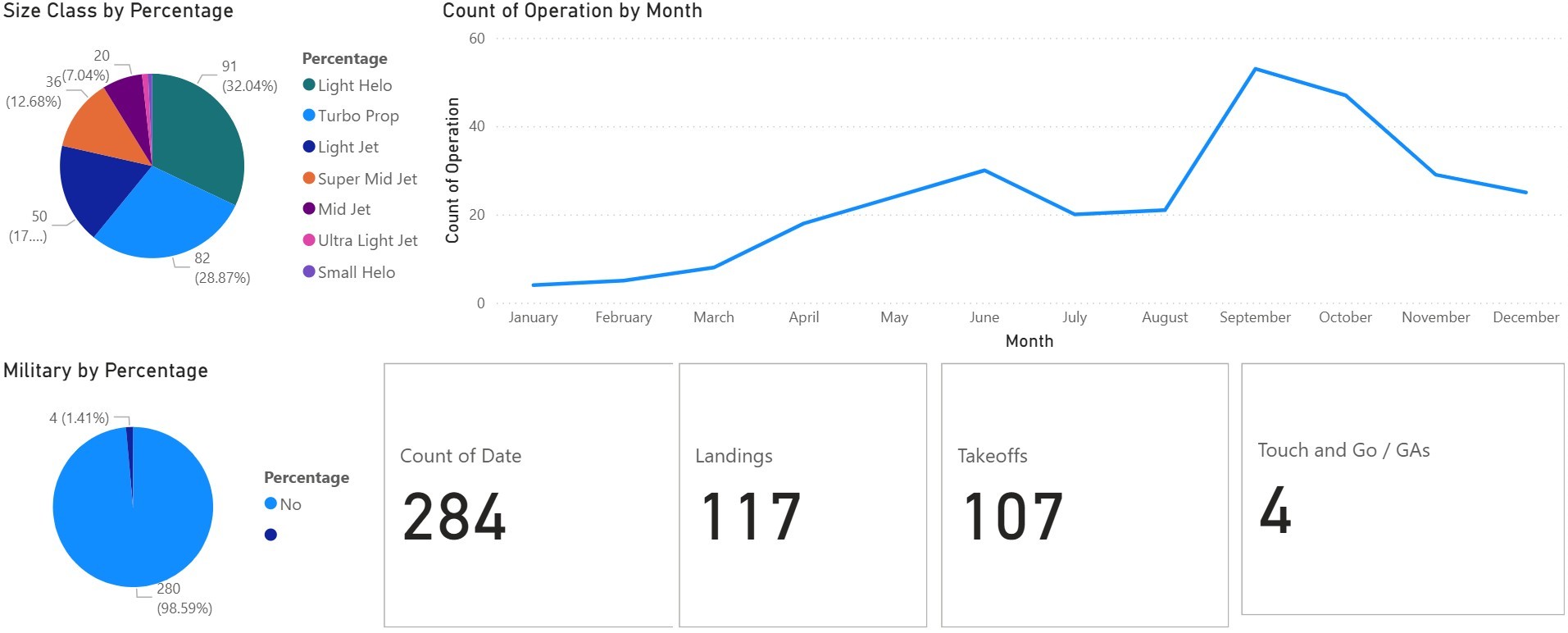
289 total operations (122 takeoffs, 111 landings)
Click to enlarge
2026 Civilian Jets & Helos (Year to Date)
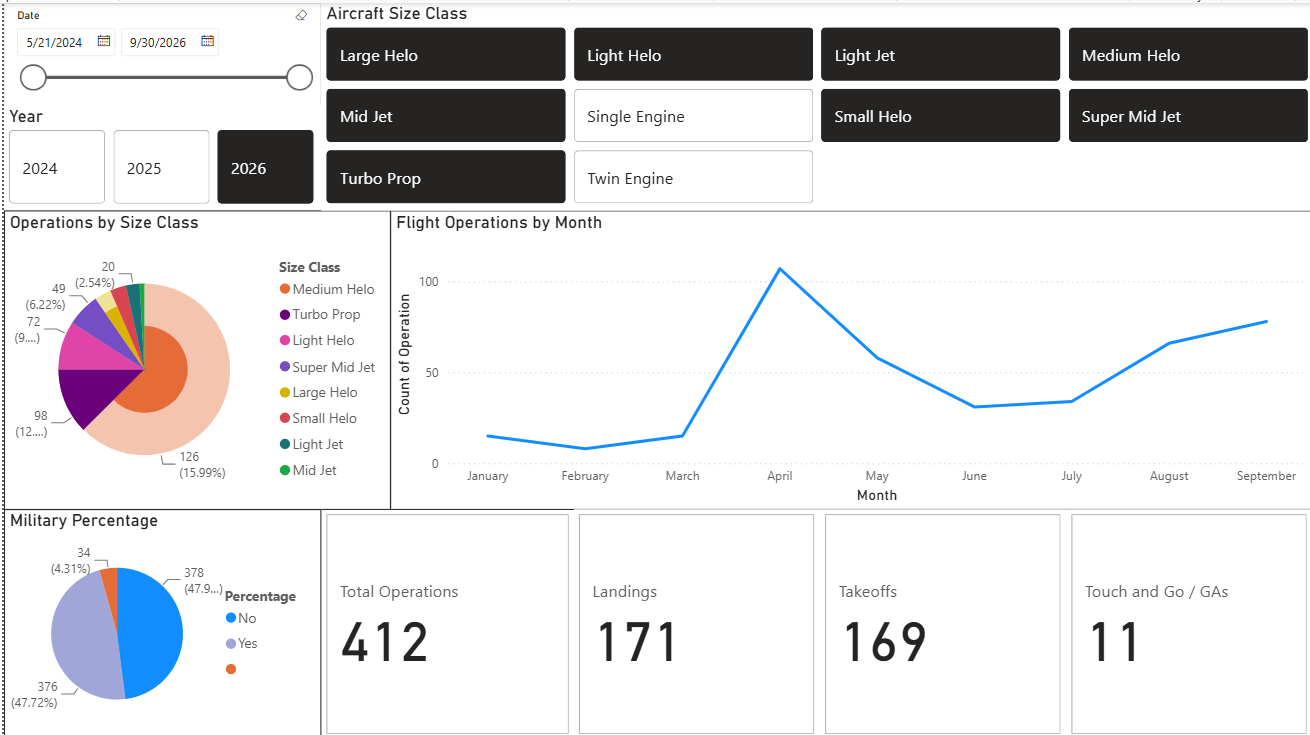
412 recorded operations (171 landings, 169 takeoffs, 11 touch-and-go)
Click to enlarge
Military Operations
Perry Stokes Airport serves as a key refueling and training location for Army rotary-wing units. The charts below show military reservation and mission data. After the anticipated slow period during Fort Carson's deployment, Fort Carson aircraft are returning to the Piñon Canyon Maneuver Site (PCMS) and KTAD in growing numbers. Military sales are expected to gradually return to 2025 levels over the next three months, with full training volumes resuming in February and March 2027.
2024 Military Operations
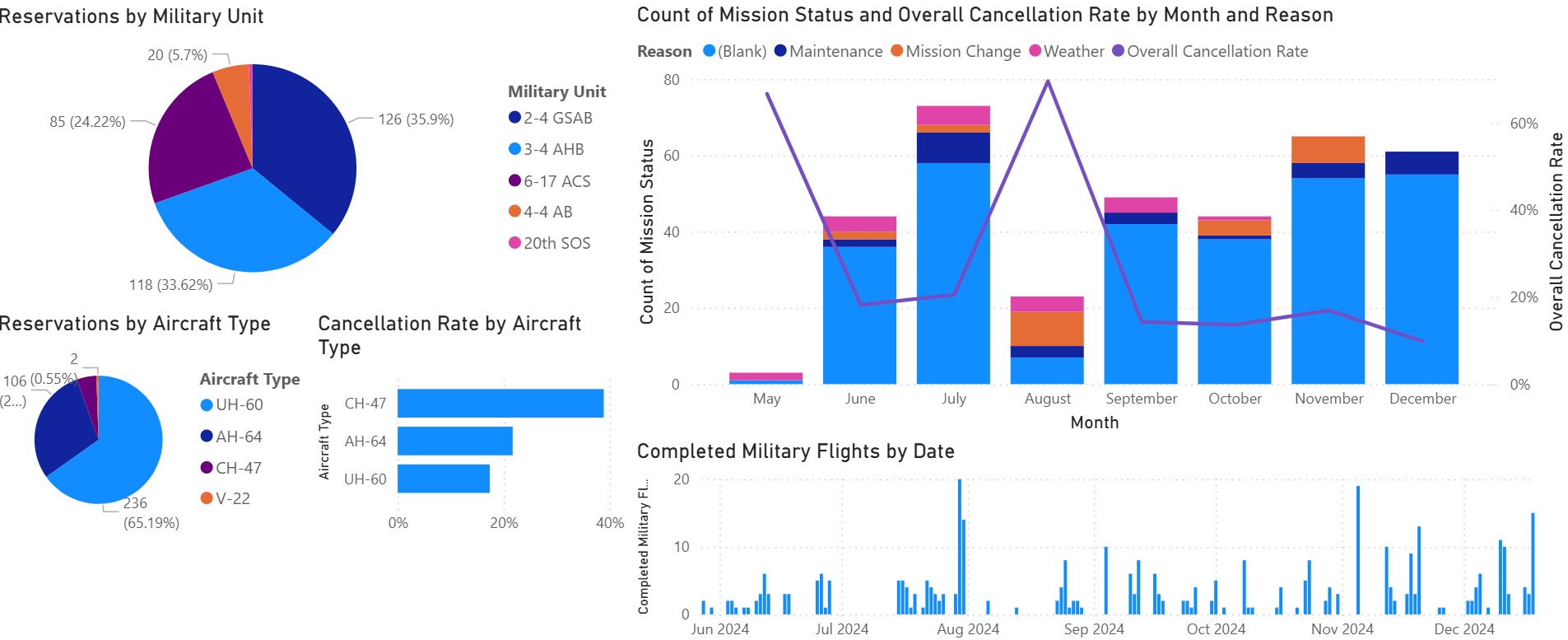
Click to enlarge
2025 Military Operations
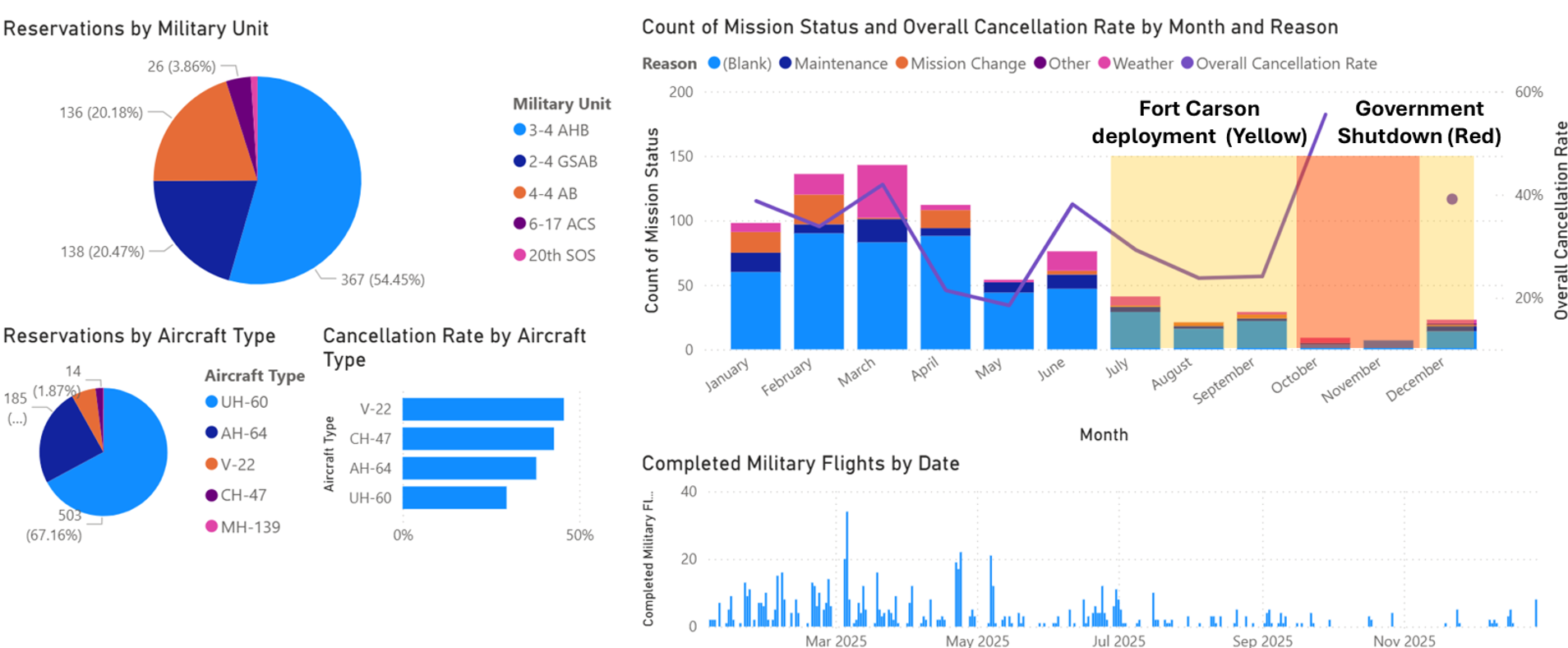
Click to enlarge
2026 Military Reservations (Year to Date)
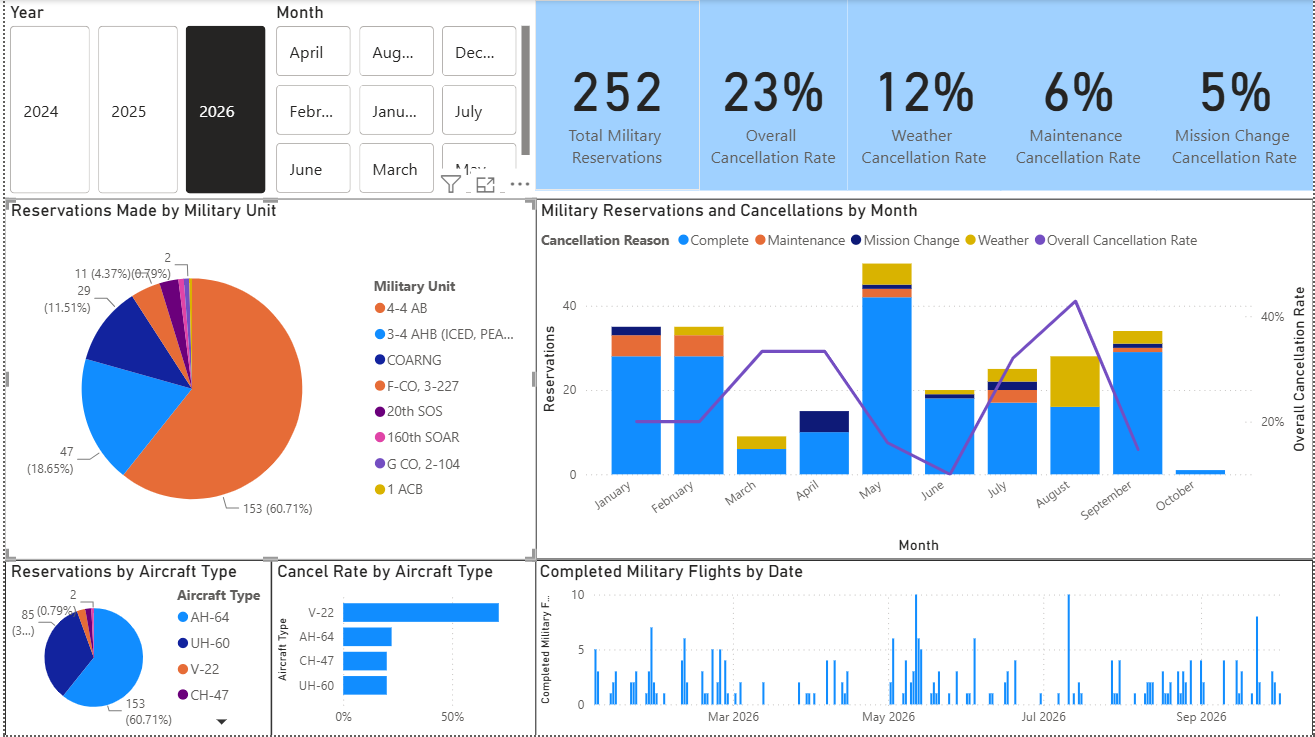
Click to enlarge
Total Airport Operations
The loss of the CAE flight school in Pueblo resulted in a 35-40% reduction in total operations throughout 2026. While this may seem troubling, it is important to remember that CAE traffic was non-revenue generating: high operation counts, but extremely low fuel volumes and minimal local economic impact. Our revenue-generating customers have continued to grow with improvements to services and facilities at the airport.
2024 Total Operations
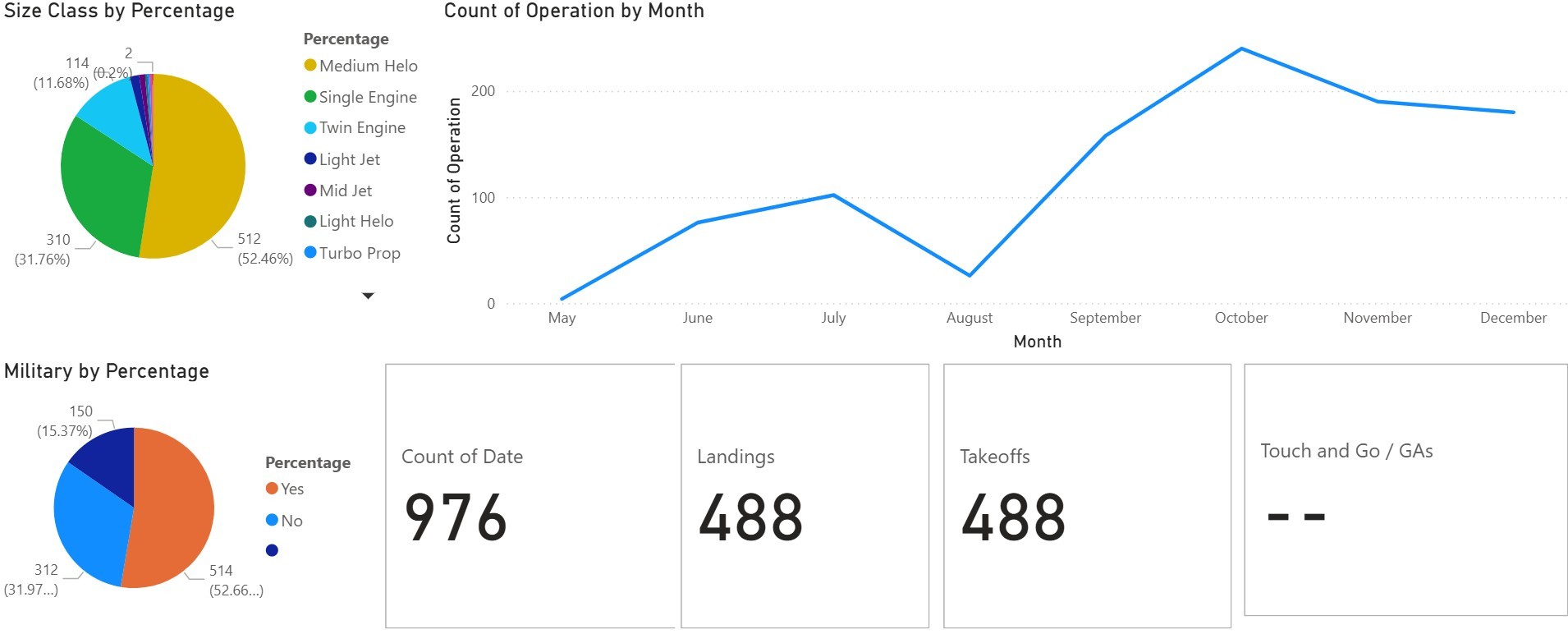
976 operations (488 landings, 488 takeoffs)
Click to enlarge
2025 Total Operations
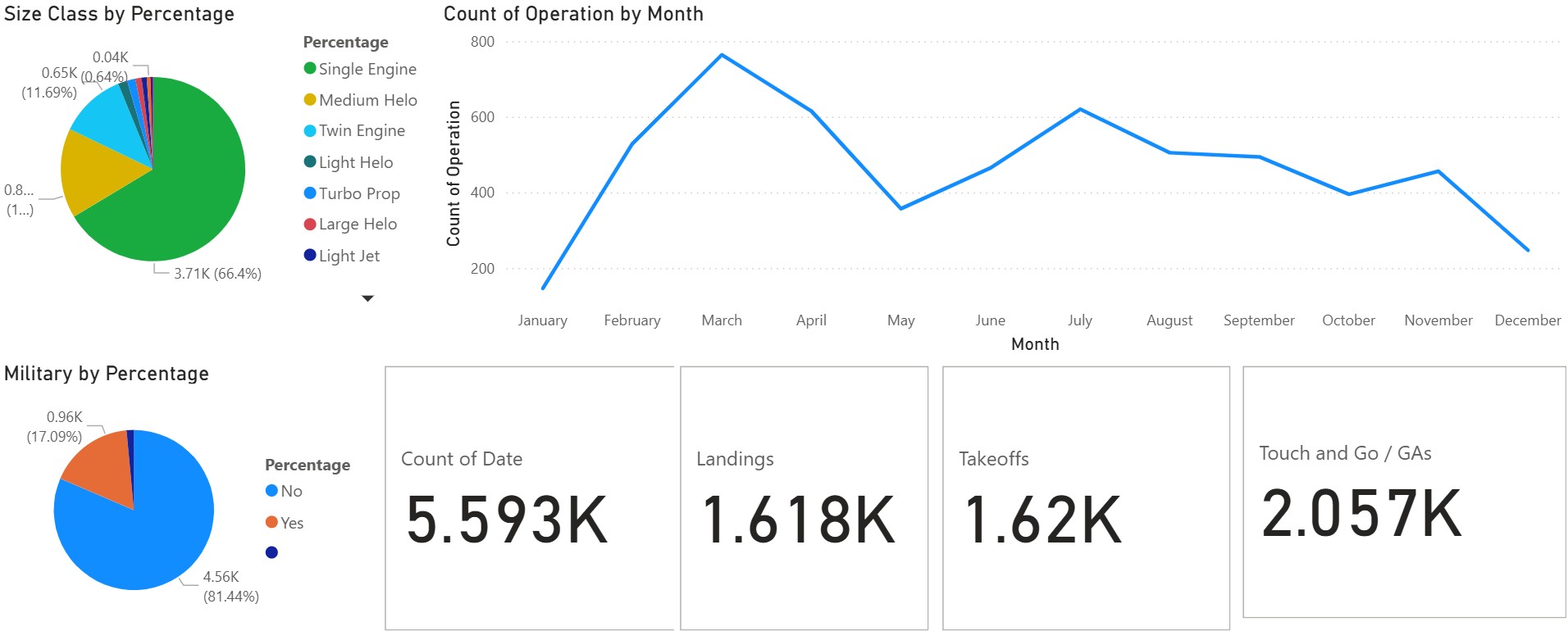
5,593 operations (1,618 landings, 1,620 takeoffs, 2,057 touch-and-go)
Click to enlarge
2026 Total Operations (Year to Date)
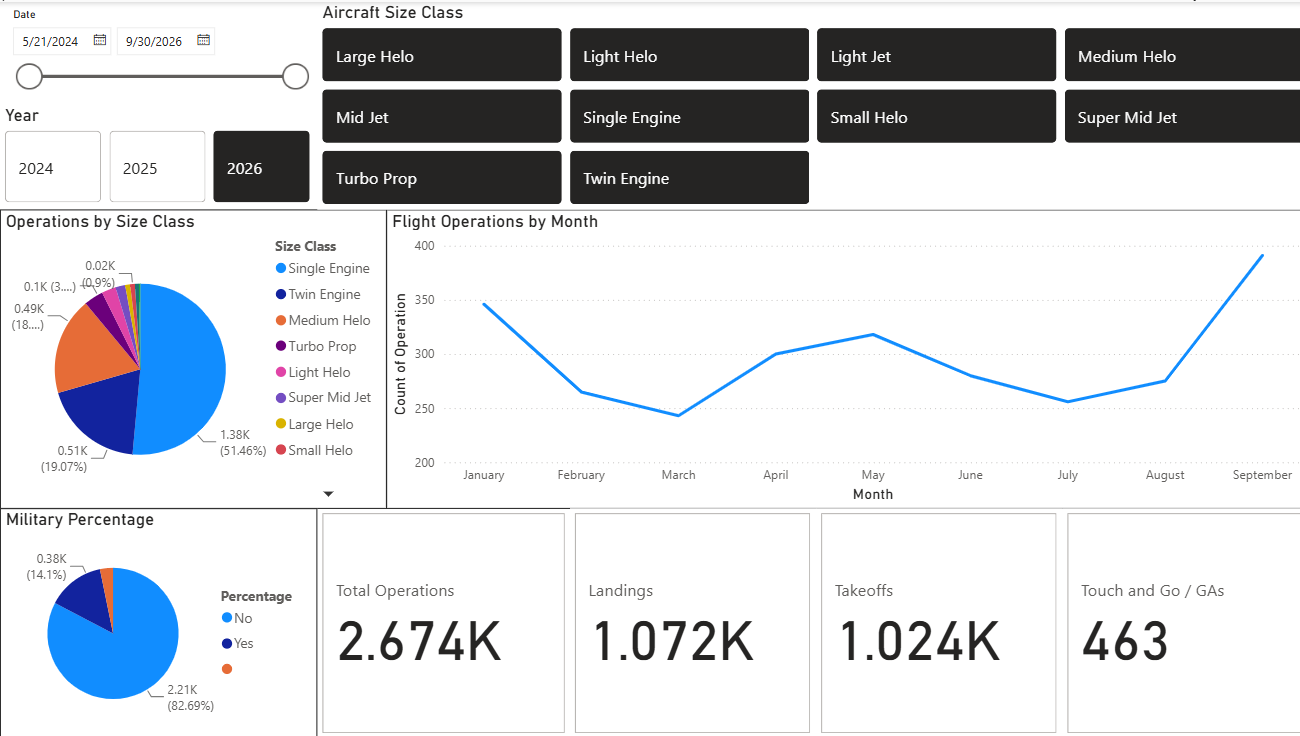
2,674 operations (1,072 landings, 1,024 takeoffs, 463 touch-and-go/go-arounds)
Click to enlarge
Airport Growth Targets
Hangars and Parking
| Hangars and Parking | 2025 (Actual) | 2030 (Projected) | 2035 (Target) |
|---|---|---|---|
| T-Hangars | 22 | 22 | 22 |
| Privately Owned Hangars | 1 | 4 | 6-12 |
| Overnight Hangar Parking Capacity | 0 | 3 | 3 |
| Jet Parking Spots (Hangar+Outdoor) | 4 | 10 | 10 |
Annual Operations
| Annual Operations | 2025 (Actual) | 2030 (Projected) | 2035 (Target) |
|---|---|---|---|
| Passenger Enplanements | Est 624 | Est 936 | Est 1,344 |
| Business Aviation Operations (Jets+Multi Engine) | 886 (156 jets) | 1,146 (234 jets) | 1,248 (336 jets) |
| Military Aviation Operations (Helicopters) | 668 | 835 | 800 |
| General Aviation Operations (Single Engine) | 7,582 | 9,098 | 12,100 |
Fuel Flowage
| Fuel Flowage | 2025 (Actual) | 2030 (Projected) | 2035 (Target) |
|---|---|---|---|
| Business Aviation Fuel Sales (Jet-A) | 12,376 gal | 24,752 gal | 67,200 gal |
| Military Aviation Fuel Sales (Jet-A) | 155,334 gal | 240,000 gal | 300,000 gal |
| General Aviation Fuel Sales (AVGAS) | 31,364 gal | 37,636 gal | 45,000 gal |
Annual Revenues Generated
| Annual Revenues Generated | 2025 (Actual) | 2030 (Projected) | 2035 (Target) |
|---|---|---|---|
| Flowage Fees paid to LAC | $0 | $15,119 | $20,610 |
| Ground Leases paid to LAC | $1,351 | $6,302 | $11,304 |
| Sales Taxes Paid | $8,848 | $15,718 | $18,136 |
| Fuel Excise Taxes (Fed and State) | $12,378 | $14,480 | $27,994 |
| Payroll Taxes (employee and employer) | $37,796 | $52,914 | $75,592 |
| Total Fed, State, and Local Revenue | $60,373 | $104,533 | $153,636 |
Economic Impacts
| Economic Impacts | 2025 (Actual) | 2030 (Projected) | 2035 (Target) |
|---|---|---|---|
| Direct Employment | 5 | 7 | 10 |
| Indirect Employment (CEIS Airport Study) | Est 35 | Est 49 | Est 70 |
| FBO Local Spend (includes Payroll) | $254,888 | $318,610 | $509,776 |
| Estimated Direct Impact to Tourism (estimated $640 per enplaned passenger) |
Est $399,360 | Est $599,040 | Est $860,160 |
Proposed Airport Fee Schedule
Airport Owned Hangar Monthly Rental
| Airport Owned Hangar Monthly Rental | Current | 2030 | 2035 |
|---|---|---|---|
| T-Hangar Current rate begins 2027 |
$175/mo legacy tenants $250/mo new tenants |
$250/mo | $325/mo |
| End Storage Unit, Medium | $100/mo | $116/mo | $135/mo |
| End Storage Unit, Large | $125/mo | $145/mo | $170/mo |
Ground Lease Rates (On New Leases)
| Ground Lease Fee | Rate |
|---|---|
| Ground Lease Rate (all lot sizes) | $0.20/sf per year |
| Initial Application Fee | $3,500 (one time) |
- Escalation: Rates increase $0.03 per square foot every 5 years. Lessees pay a fixed rate for each 5-year period ($0.20, $0.23, $0.26, $0.29, and $0.32/sf over a 25-year term).
- Lot Size Requirements: Lease rates apply to the entire lot size. Minimum setbacks: 15 feet from taxilane, 10 feet from side and rear lot lines. Septic systems must be at least 10 feet from all lot boundaries.
- Lease Terms: Standard 25-year lease with two 10-year renewal options (45 years maximum).
Example Ground Lease Calculations
The following examples illustrate annual lease payments over a 25-year lease term at $0.20/sf, increasing $0.03/sf every 5 years:
| Example Hangar | Years 1-5 $0.20/sf |
Years 6-10 $0.23/sf |
Years 11-15 $0.26/sf |
Years 16-20 $0.29/sf |
Years 21-25 $0.32/sf |
|---|---|---|---|---|---|
| 60' × 60' Hangar with Septic 7,350 sf lot |
$1,470/yr $123/mo |
$1,691/yr $141/mo |
$1,911/yr $159/mo |
$2,132/yr $178/mo |
$2,352/yr $196/mo |
| 90' × 120' Hangar with Septic 18,900 sf lot |
$3,780/yr $315/mo |
$4,347/yr $362/mo |
$4,914/yr $410/mo |
$5,481/yr $457/mo |
$6,048/yr $504/mo |
Fuel Flowage Fees
Fuel flowage fees to Las Animas County are $0.05 per gallon. Projected fees at forecasted fuel volumes:
| Year | Projected Fuel Flow | Flowage Fee Rate | Flowage Fees to LAC |
|---|---|---|---|
| 2027 | 150,000 gallons | $0.05/gallon | $7,500 |
| 2028 | 175,000 gallons | $0.05/gallon | $8,750 |
| 2029 | 200,000 gallons | $0.05/gallon | $10,000 |
Capital Improvement Plan (CIP) FY 2026-2035
The CIP represents the programmed infrastructure investments for Perry Stokes Airport, coordinated between Las Animas County and the FAA. This 10-year plan identifies funded projects, funding sources, and long-term priorities necessary to support airport growth.
| Year | Project | FAA Discretionary | FAA State Apportionment | FAA Entitlements | Colorado Discretionary | Local | Passenger Facility Charge | Total Funding | Project Cost Estimate | Comments |
|---|---|---|---|---|---|---|---|---|---|---|
| 2026 | Carryover to 2030 | — | — | — | — | — | — | — | — | |
| 2027 | Transfer to Pagosa Springs | — | — | — | — | — | — | — | — | |
| BIL Allocation - Transient Apron/Helicopter Parking Pad Phase 1 Construction | — | — | $439,000 | $11,552 | $11,553 | — | $462,105 | $1,292,100 | *PRIORITY 1B* Using all available ENT (2028/2029/2030 and requesting CDOT overmatch of $500,000 | |
| Overmatch Transient Apron/Helicopter Parking Pad Phase 1 Construction | — | — | — | $500,000 | $55,556 | — | $555,556 | $1,292,100 | *PRIORITY 1B* Using all available ENT (2028/2029/2030 and requesting CDOT overmatch of $500,000 | |
| Transient Apron/Helicopter Parking Pad Phase 1 Construction | — | — | $102,224 | $2,690 | $2,691 | — | $107,605 | $1,292,100 | *PRIORITY 1B* Using all available ENT (2028/2029/2030 and requesting CDOT overmatch of $500,000 | |
| 2028 | Transfer to Salida | — | — | — | — | — | — | — | — | |
| 2029 | Transfer to Sterling | — | — | — | — | — | — | — | — | |
| Taxi Lane Extension | — | — | — | — | — | — | — | $714,700 | *PRIORITY 2* Locally funded to drive Hangar Development (if Apron/Helicopter Parking is funded by other sources, this becomes Priority 1. | |
| 2030 | Transient Apron/Helicopter Parking Pad Phase 2 Construction | — | — | $600,000 | $33,333 | $33,334 | — | $666,667 | $1,292,100 | Transfers from Pagosa Springs, Salida, and Sterling. |
| 60x60 Hangar | — | — | — | — | $506,500 | — | $506,500 | $506,500 | FBO/County/Other Funding | |
| Overmatch Transient Apron/Helicopter Parking Pad Phase 2 Construction | — | — | — | $650,000 | $72,222 | — | $722,222 | $1,292,100 | *PRIORITY 1B* Using all available ENT (2028/2029/2030 and requesting CDOT overmatch of $650,000 | |
| 2031 | Pavement Maintenance | — | — | — | — | $48,930 | — | $48,930 | $489,300 | CDOT /Local Funding Request CDOT Funding $440,370.00 |
| Transfer to Steamboat Springs | — | — | — | — | — | — | — | — | Carryover 2031 to 2034 | |
| 2032 | Transfer to Sterling | — | — | — | — | — | — | — | — | Carryover 2032 ENT to 2034 |
| 2033 | Transfer to Buena Vista | — | — | — | — | — | — | — | — | Carryover 2033 ENT to 2034 |
| 2034 | Runway 3 Taxiway Turnaround Ph 1 | — | — | $600,000 | — | $99,999 | — | $699,999 | $2,159,900 | *PRIORITY 3* Using all available ENT (2031/ 2032/ 2033/ 2034 transfers from SBS, STK and AEJ) and requesting CDOT overmatch of $650,000 (Project could be phased, 1-Design/Earthwork; 2-Pavement Section. Potentially target two transfer programs) |
| 2035 | Runway 3 Taxiway Turnaround Ph 2 | — | $600,000 | $600,000 | $666,666 | $666,667 | — | $2,533,333 | $2,159,900 | *PRIORITY 3* Using all available ENT (2035/36/37/38 transfers from? ? and ?) and requesting CDOT overmatch of $650,000 (Project could be phased, 1-Design/Earthwork; 2-Pavement Section. Potentially target two transfer programs) |
| Long Term | Partial Parallel Taxiway A (A2 to A3) | — | $4,000,000 | — | — | — | — | $4,000,000 | $2,266,000 | 2031 - 2034 Entitlements |
| Runway 3-21 Reconstruction 2035-2039 | — | — | — | — | — | — | — | $6,000,000 | ||
| Runway 3-21 Extension | — | — | — | — | — | — | — | — | Extension Length TBD | |
| Expand Aircraft Parking Apron and Correct Direct Apron Access | — | — | — | — | — | — | — | $1,000,000 | ||
| Partial Parallel Taxiway A (A5 to A6) | — | — | — | — | — | — | — | $3,000,000 |
Source: FAA WIMS CIP Worksheet. Dashes indicate $0 or no amount entered.
Unmet Funding Requirements
The following projects represent immediate priorities that currently lack secured funding. These investments are critical to supporting airport growth and military readiness.
| Project | Purpose | Estimated Cost | Available Funding & Source | Funding Needed | Status |
|---|---|---|---|---|---|
| Taxilane Extension | Opens 6 new affordable ground lease spots for private hangar construction. Phase 1 (2026) opens the first two hangar lots. | $366,388 Full build-out estimate |
~$101,000 County: Asphalt $50k (contracted) + In-Kind Base Work $35k + CatEX ~$16k (paid) |
~$265,388 | Applying for Energy Impact Grants to Fund in 2027 |
| Terminal MEP & Windows | Historic terminal climate control upgrades, electrical panel upgrades to remove safety and power availability hazards, new period-appropriate energy-efficient windows, roof membrane replacement, and a commercial water heater upgrade | $257,660 ATP grant application estimate |
— | $257,660 | No Grant Source Identified ATP grant not funded |
| Hot Refuel Pads | Hot Refuel area to separate helicopter and plane traffic while increasing overall airport capacity | $2,466,845 | — PJC up to $50k committed if CPF/CDS funding is approved |
$2,466,845 | Awaiting Results of 2027 CPF and CDS Funding |
Airport Layout Plan (ALP)
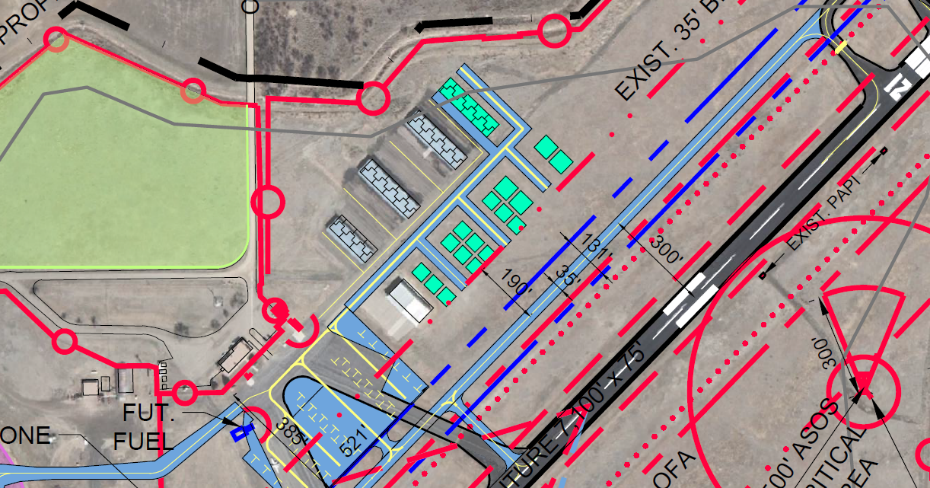
The proposed Airport Layout Plan shows the planned development areas, runway safety zones, and future infrastructure projects. This plan guides all airport development and must be approved by the FAA for any federally-funded improvements.
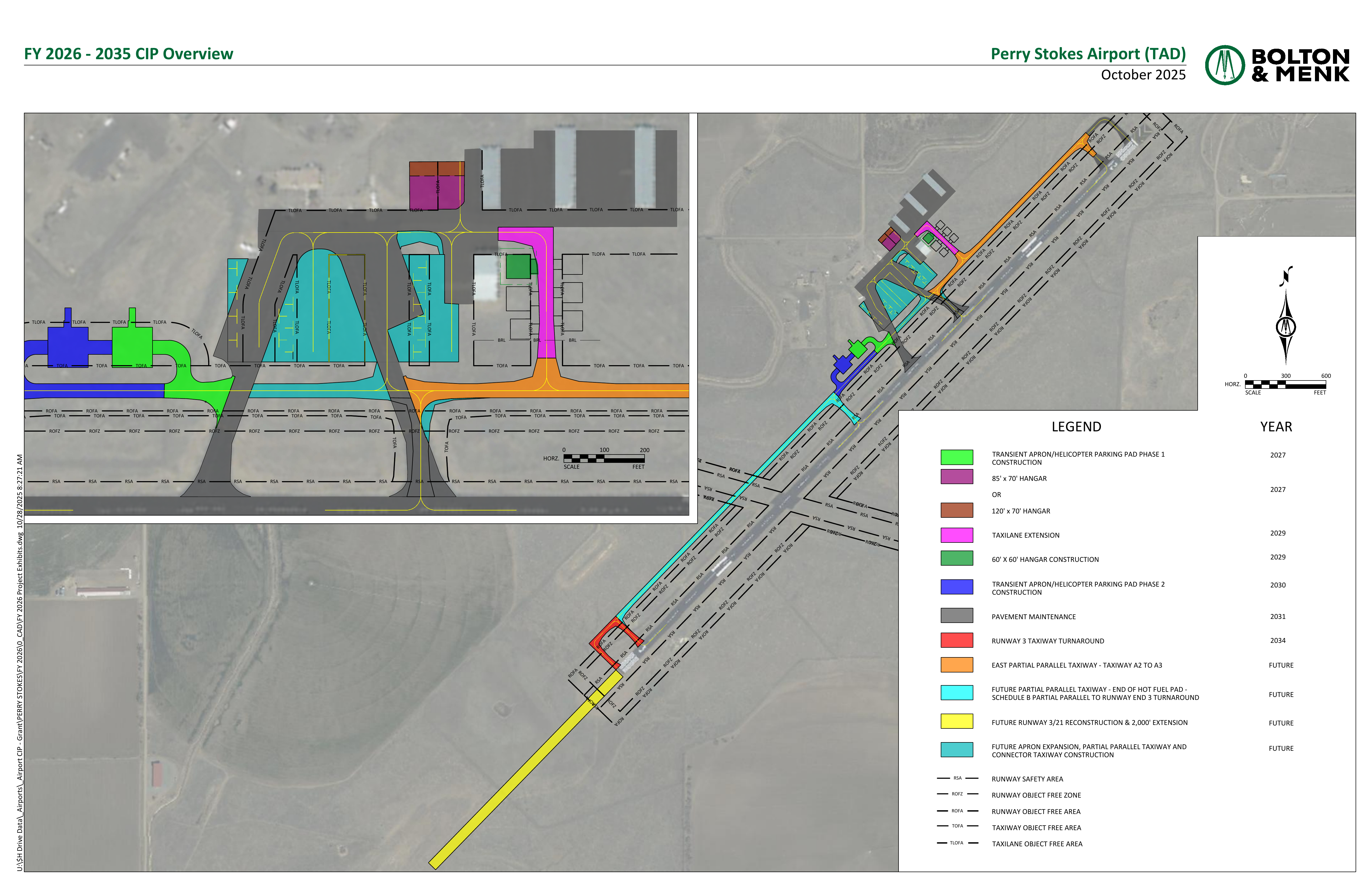
Click image to enlarge
Key Development Areas Shown:
- 2027: Transient Apron/Helicopter Parking Pad Phase 1
- 2029: Taxilane Extension, 60'x60' Hangar Construction
- 2030: Transient Apron/Helicopter Parking Pad Phase 2
- 2031: Pavement Maintenance
- 2034: Runway 3 Taxiway Turnaround
- Future: Partial Parallel Taxiways, Runway Extension, Apron Expansion
2025 Colorado Aviation Economic Impact Study
The Colorado Department of Transportation (CDOT) Division of Aeronautics conducted the 2025 Colorado Aviation Economic Impact Study to understand how Perry Stokes Airport (TAD) supports economic activity. The study found that TAD generated $2.5 million in total business revenues, supporting 14 jobs and $770,000 in payroll in 2023.
2025 Projects
Bathroom Renovation
2025 • In ProgressStorage Unit Buildout
2025 • In ProgressSeptic System
2025 • Complete2026 Projects
Apron & Teacup Crack Repairs
Spring 2026Airport Seal Coat
Spring 2026Private Hangar Taxilane
2026Rental Car Service
Spring 2026New Radio Frequency (CTAF)
Spring 2026Terminal Renovation
2026-2027If Not Awarded: PJC $48,000
Airport Minimum Standards
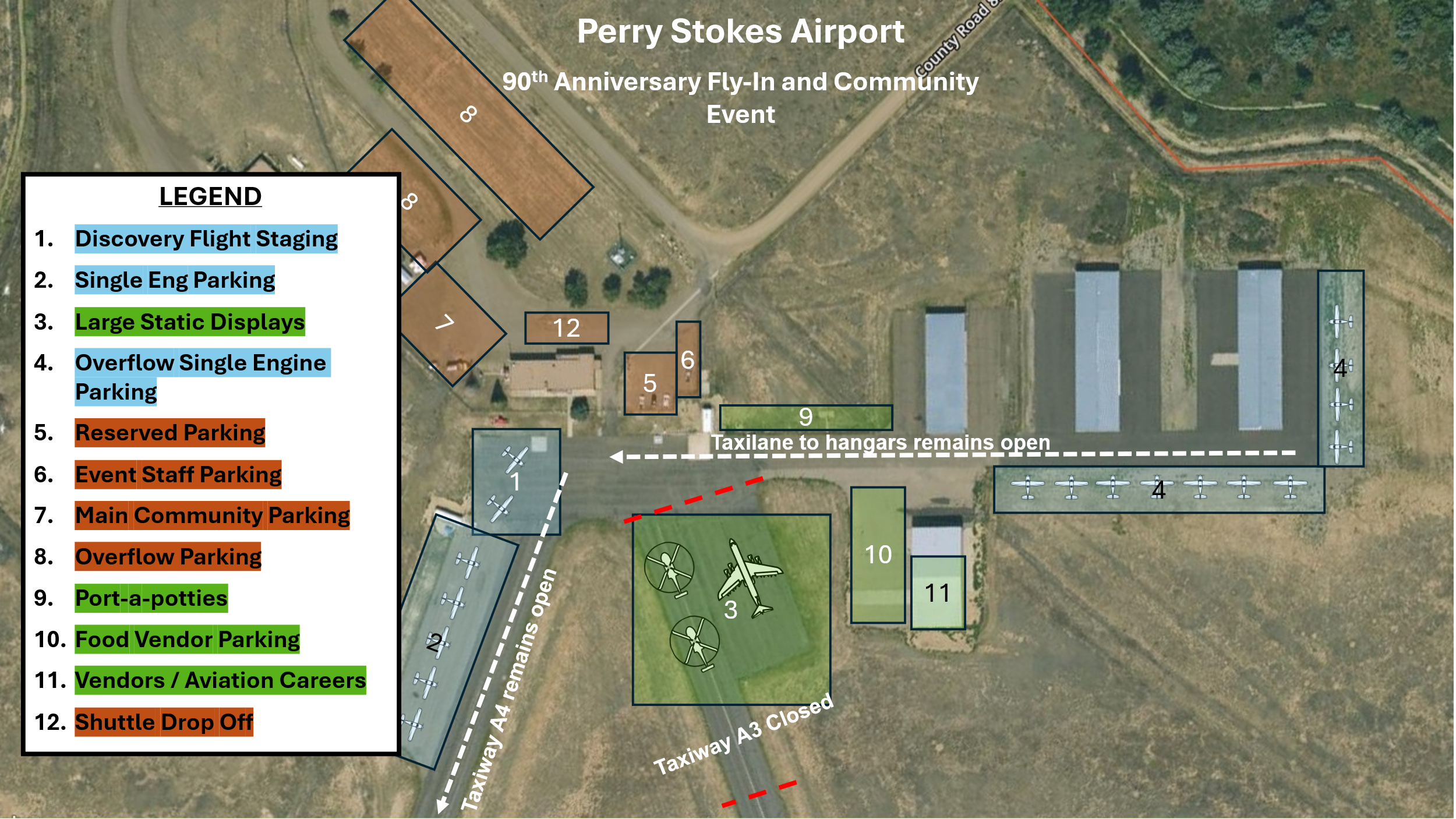
Fall 202690th Anniversary Fly-In & Community Event
August 202690th Anniversary Event Layout
2027 Projects
Establish Perry Stokes Airport Authority
January 2027• Reduces BOCC approval burden for routine decisions, such as renewing leases
Main Hangar Construction
Summer 2027• Double business aviation fuel sales (12K→24K gal/yr)
• ~100 additional monthly tourist visits by 2030
• Est. $768,000/year local economic impact
Full Service FBO Equipment
Jan-Jul 2027• Lavatory service cart
• Ground Power Units (GPU) with electrical infrastructure
• De-ice cart for winter operations
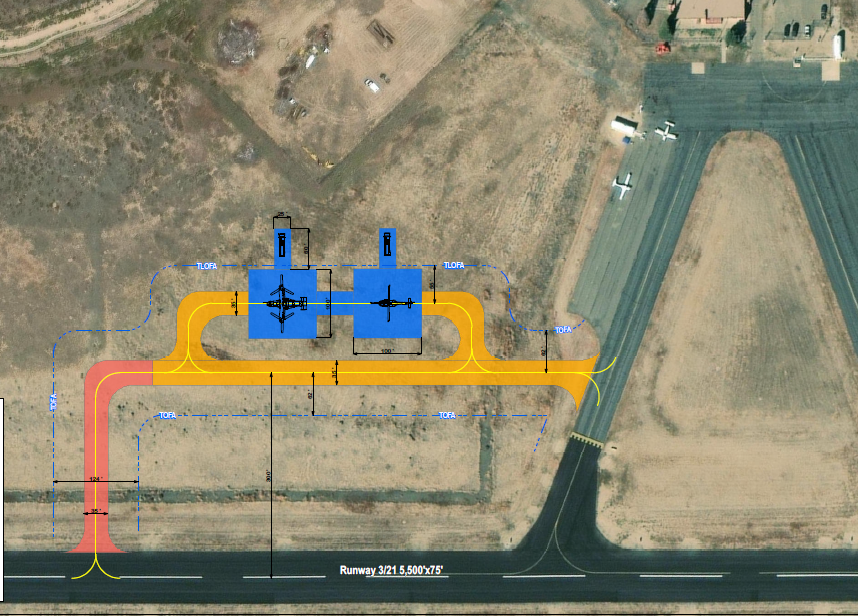
Dedicated Hot Refuel Point Installation
2027-2030Capacity: Double fuel throughput for large helicopter flights (4+ aircraft).
Backup: FAA/CDOT Discretionary Funds
Local Match: Up to 5%
Schedule B (South Pad): 2028-2029
Schedule C (Optional Taxiway): 2029-2030
Hot Refuel Point Design
Blue = Schedule A (North Pad) • Yellow = Schedule B (South Pad + Taxiway) • Red = Schedule C (Optional)
2028-2029 Projects
Private Hangar Development
2028-2029AVGAS Fuel Truck
2028DLA & CAA Fuel Contracts
2028Parking Lot Repairs
2028Airport Layout Plan - Future Hangar Development Areas
Green areas indicate planned private hangar development zones